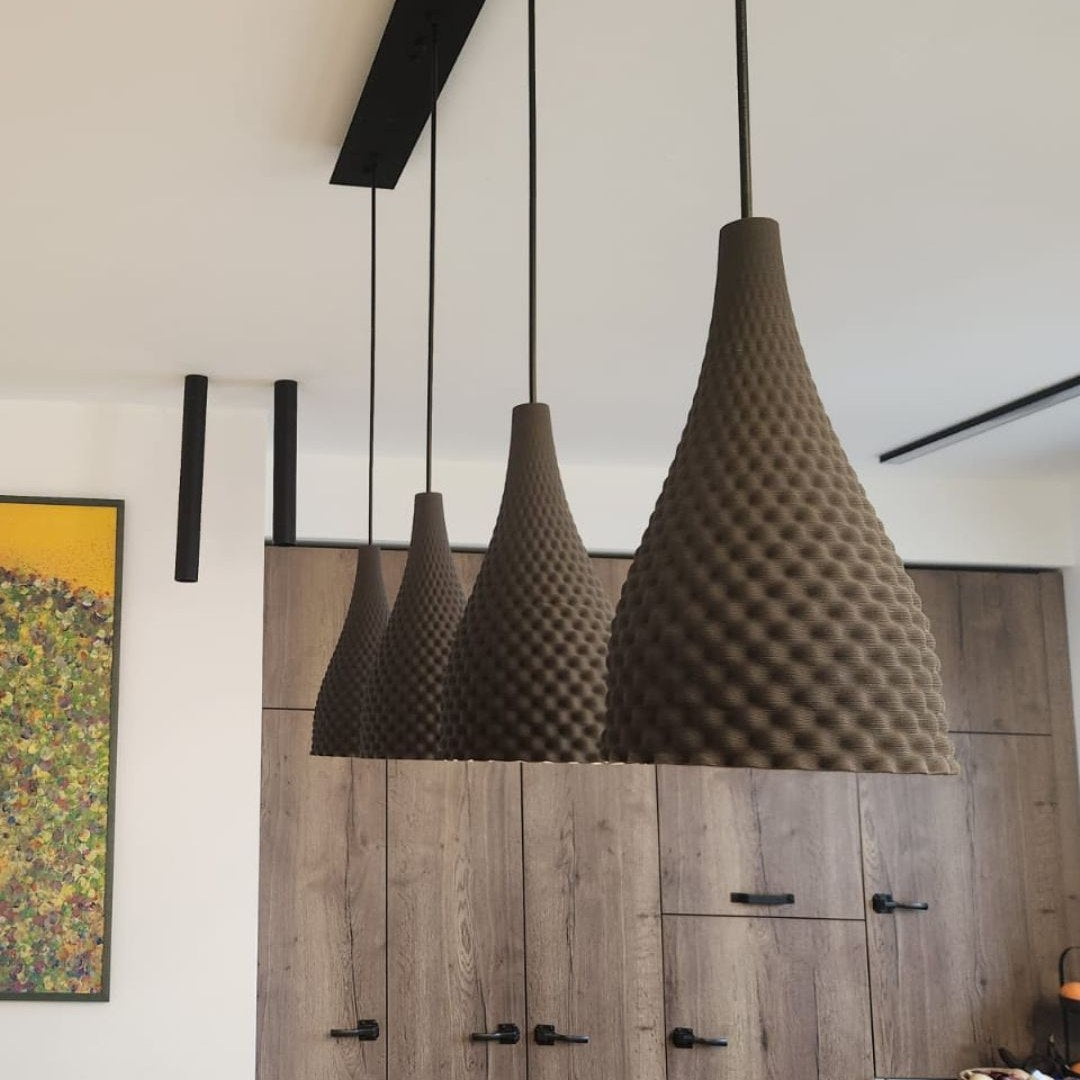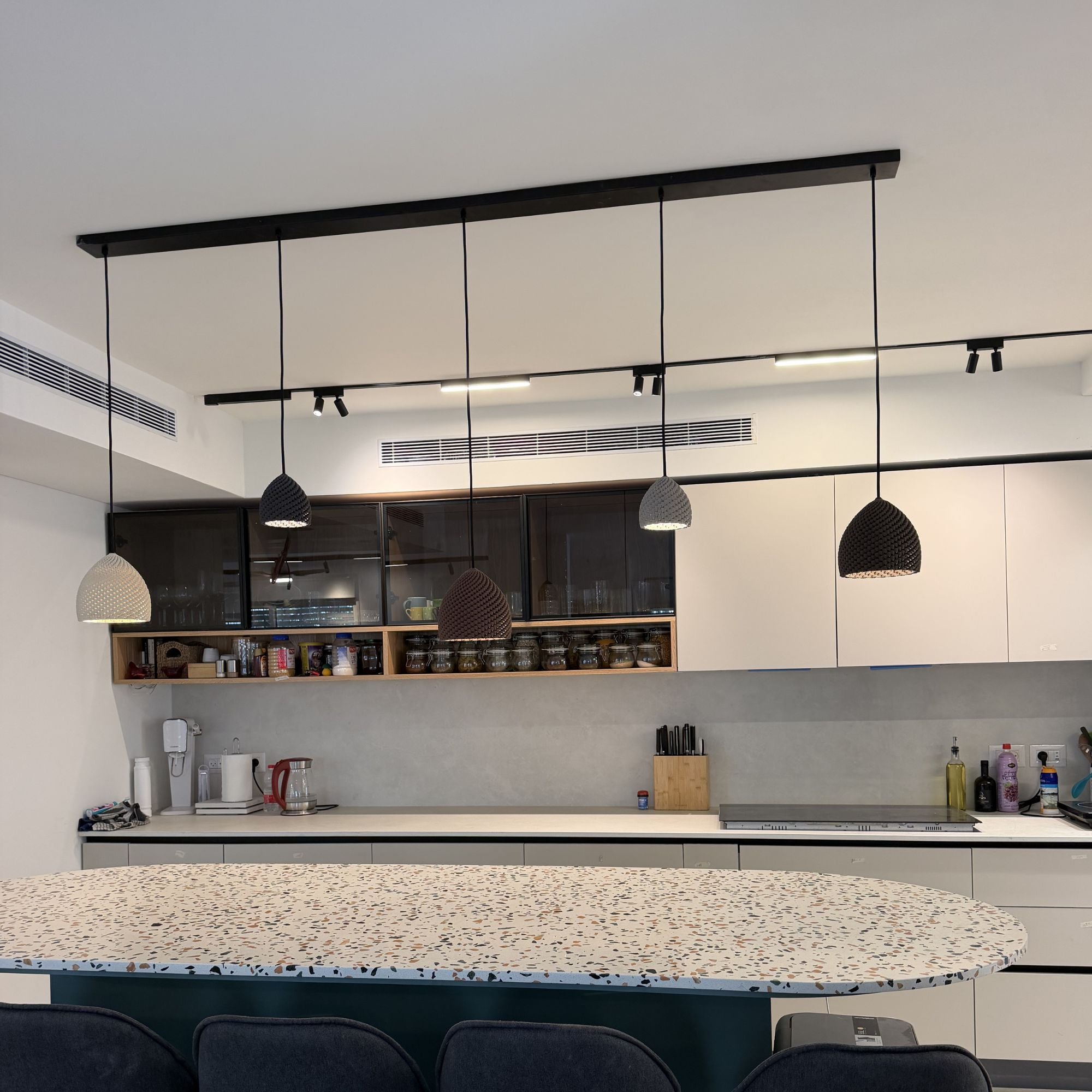


A pendant light over a dining table should hang so that the bottom of the shade is 75-100 cm (30-40 in) above the tabletop. This is the range that lights the table in a focused way, doesn't dazzle the people sitting there and doesn't block the sightline between them. Height is always measured from the tabletop, not from the floor, so with a standard table the bottom of the shade will be 150-175 cm (59-69 in) from the floor. When you plan lighting over a dining table, decide on quantity and size together with the height: the width of the lamp, or of the whole arrangement, should be between one third and two thirds of the table's width - over a round table, one central fixture or a cluster works beautifully, and over a long rectangular table, two or three fixtures evenly spaced. With a low ceiling you stay in the same range, because nobody walks under the lamp above the table. The right height is the difference between a lamp that simply hangs in the room and one that frames the table, creates an intimate mood around the meal and makes the dining area the heart of the home.
At our studio we design and make dining room pendant lights from 3D printed ceramic, and this guide gathers what we have learned from installations in real homes.
Why 75-100 cm above the table?
At this height the light is focused on the table, not in people's eyes: the bottom of the shade sits below the eye line of someone standing, but above the sightline of those sitting - so nobody is dazzled and nobody has to lean over to see the person opposite.
This range also creates the framing effect: the lamp, the table and the warm light together make a "room within a room". Too low - the lamp hides faces and gets in the way; too high - the light scatters, the intimate mood is lost and the lamp looks disconnected from the table.
Remember: height is measured from the tabletop, not from the floor. A standard dining table is about 75 cm (30 in) high, so the bottom of the shade will usually be 150-175 cm (59-69 in) from the floor.
Height and position by table type
Long rectangular table
Over a table of 1.8-2.4 m (6-8 ft), two or three fixtures evenly spaced along the table's axis look balanced - or an elongated canopy carrying several shades. Leave about 40 cm (16 in) between the end of the table and the outermost fixture, so the arrangement "sits" within the table's edges.
Round table
A cluster of several shades at staggered heights (differences of 15-25 cm / 6-10 in) creates a sculptural effect that works especially well over a round table - or alternatively, one fixture in the centre.
Extending table
Always plan for the closed size - that's how the table is most of the year. If you extend the table often, an elongated canopy with several shades gracefully covers the extension too.
How many lamps do you need - and what size?
The rule of thumb does most of the work: the width of the lamp (or of the whole arrangement) should be between one third and two thirds of the table's width. For example, over a table 90 cm (35 in) wide, a lamp 30-60 cm (12-24 in) in diameter suits, or an arrangement of a similar overall width.

One large lamp creates a quiet, dramatic focal point; several small shades create rhythm and movement along the table - and an odd number usually reads as more balanced. From our collection: the Negev pendant light works beautifully as a set of three over a long table, and the small Sahara, with its geometric texture, suits an arrangement of several shades along the table, or in a circle over a round table.
Material, light and mood
In a dining area the light should be warm and inviting: an LED bulb of 2700K-3000K flatters both food and faces. Ceramic and porcelain shades soften the light through their texture and create a pleasant glow instead of a harsh point of light - we wrote about the differences between the materials in detail in our post on porcelain and clay. A dimmer is highly recommended: the same lamp then moves from a bright lunch to an intimate evening at the press of a button.
Common mistakes to avoid
- Hanging too high - the most common mistake. The lamp loses its connection to the table and the light glares instead of wrapping the space.
- A lamp too small for the table - it looks lost instead of working as a focal point.
- Centring on the room instead of the table - hang the lamp over the centre of the table, even when the table isn't exactly in the centre of the room.
- A bare bulb at eye level - with a shade open at the bottom, choose a dimmed bulb or a shade that hides the bulb from the sightline.
- Skipping the dimmer - even the most beautiful lamp loses its mood under full, constant light.
Frequently asked questions
What if the ceiling is low?
Even with a 2.5 m (8.2 ft) ceiling, stay in the 75-100 cm (30-40 in) range above the table. The table area is the only place in the room where a lamp naturally "comes down low", because nobody walks beneath it. With low ceilings, it's better to choose a slim, vertical shade that doesn't take over the volume.
How do I coordinate the dining area with an open kitchen?
When the kitchen and the dining area share one space, the light fixtures should share a language - the same material, the same colour family or the same series in different sizes. We expanded on this in our kitchen lighting guide. And if you have a kitchen island, we gathered the exact height, quantity and spacing in our guide to lighting over a kitchen island. When the living room is in the same open space, it's worth keeping the design language with the living room pendant lights too.
What if the electrical point isn't above the centre of the table?
A licensed electrician can move the point easily, and on a concrete ceiling you can also use a swag hook: the cable leaves the existing point and is shifted to above the centre of the table. As for cable length, we match each order to the exact length for your ceiling height.
The measurements are clear - now all that's left is choosing the design
Now that the numbers are clear, explore Melzer Studio's dining room pendant lights collection: 3D printed ceramic lamps with custom colour, size and cable length. That makes it easy to find a dining room light that fits your table's dimensions and your ceiling height exactly.
Want to see how it will look over your table? Send us a photo of your dining area on WhatsApp and we'll prepare a free visualisation, or book a consultation at the studio. Still deciding? Read our guide to choosing a unique pendant light as well.